Perspectives and challenges of physiotherapists, special educators and other healthcare workers in implementing eco-integration for persons with disabilities
DOI:
https://doi.org/10.17411/jacces.v16i1.636Abstract
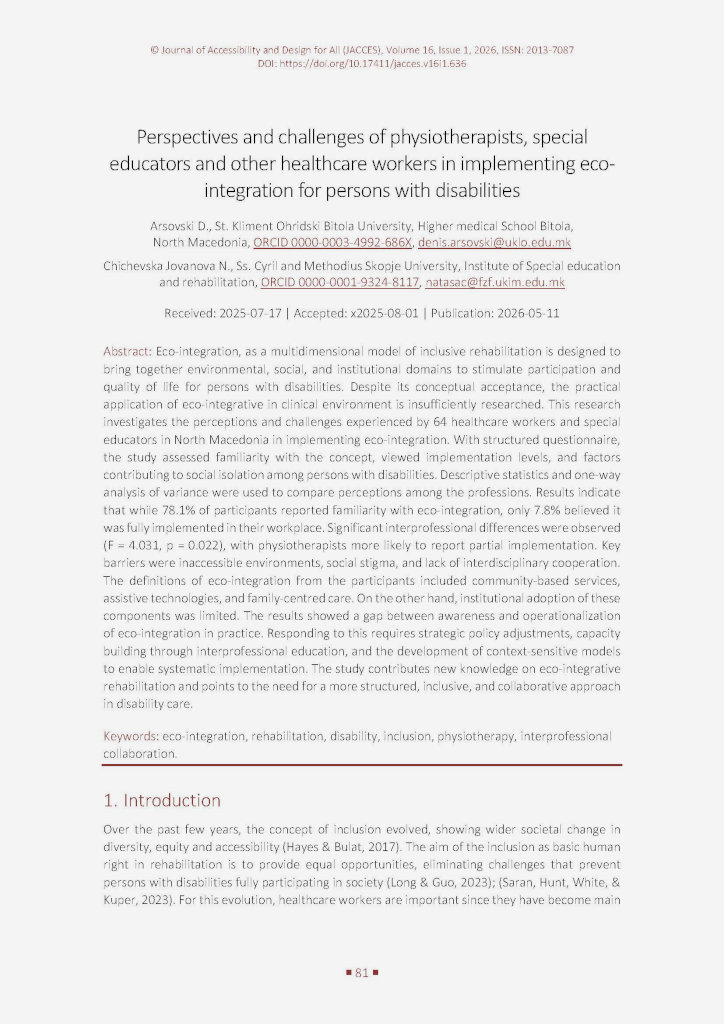
Eco-integration, as a multidimensional model of inclusive rehabilitation is designed to bring together environmental, social, and institutional domains to stimulate participation and quality of life for persons with disabilities. Despite its conceptual acceptance, the practical application of eco-integrative in clinical environment is insufficiently researched. This research investigates the perceptions and challenges experienced by 64 healthcare workers and special educators in North Macedonia in implementing eco-integration. With structured questionnaire, the study assessed familiarity with the concept, viewed implementation levels, and factors contributing to social isolation among persons with disabilities. Descriptive statistics and one-way analysis of variance were used to compare perceptions among the professions. Results indicate that while 78.1% of participants reported familiarity with eco-integration, only 7.8% believed it was fully implemented in their workplace. Significant interprofessional differences were observed (F = 4.031, p = 0.022), with physiotherapists more likely to report partial implementation. Key barriers were inaccessible environments, social stigma, and lack of interdisciplinary cooperation. The definitions of eco-integration from the participants included community-based services, assistive technologies, and family-centred care. On the other hand, institutional adoption of these components was limited. The results showed a gap between awareness and operationalization of eco-integration in practice. Responding to this requires strategic policy adjustments, capacity building through interprofessional education, and the development of context-sensitive models to enable systematic implementation. The study contributes new knowledge on eco-integrative rehabilitation and points to the need for a more structured, inclusive, and collaborative approach in disability care.
References
Babik, I., & Gardner, E. (2021). Factors affecting the perception of disability: A developmental perspective. Frontiers in Psychology, 12, 1–26. https://doi.org/10.3389/fpsyg.2021.702166
Brandt, L., Liu, S., Heim, C., & Heinz, A. (2022). The effects of social isolation stress and discrimination on mental health. Translational Psychiatry, 12. https://doi.org/10.1038/s41398-022-02178-4
Caragiani, E. S. (2020). Social and economic inclusion of disabled individuals: A literature review. Facta Universitatis, 275–284. https://doi.org/10.22190/FUEO200118020C
Connaughton, J., & Gibson, W. (2016). Do physiotherapists have the skill to engage in the “psychological” in the bio-psychosocial approach? Physiotherapy Canada, 68(4), 377–382. https://doi.org/10.3138/ptc.2015-66
Deshmukh, M., & Harjpal, P. (2024). Integrated physiotherapeutic intervention for rehabilitation of a patient with intellectual disabilities: A case report. Cureus. https://doi.org/10.7759/cureus.56476
Emerson, E., Fortune, N., Llewellyn, G., & Stancliffe, R. (2020). Loneliness, social support, social isolation and wellbeing among working age adults with and without disability: Cross-sectional study. Disability and Health Journal. https://doi.org/10.1016/j.dhjo.2020.100965
Gleadhill, C., Bolsewicz, K., Davidson, S., Kamper, S., Tutty, A., Robson, E., . . . Williams, C. (2022). Physiotherapists’ opinions, barriers, and enablers to providing evidence-based care: A mixed-methods study. BMC Health Services Research, 22, 1–16. https://doi.org/10.1186/s12913-022-08741-5
Haldane, V., Chuah, F., Srivastava, A., Singh, S., Koh, G. C., Kee Seng, C., & Legido-Quigley, H. (2019). Community participation in health services development, implementation, and evaluation: A systematic review of empowerment, health, community, and process outcomes. PLOS ONE, 1–25. https://doi.org/10.1371/journal.pone.0216112
Hayes, A., & Bulat, J. (2017). Disabilities inclusive education systems and policies guide for low- and middle-income countries. RTI Press. https://doi.org/10.3768/rtipress.2017.op.0043.1707
Hervie, V. M. (2023). Social inclusion of children with intellectual disabilities in Accra, Ghana: Views of parents/guardians and teachers. Children and Youth Services Review. https://doi.org/10.1016/j.childyouth.2023.106845
Kennedy, R., McKenzie, G., Holmes, C., & Shields, N. (2023). Social support initiatives that facilitate exercise participation in community gyms for people with disability: A scoping review. International Journal of Environmental Research and Public Health, 20(1). https://doi.org/10.3390/ijerph20010699
Khalid, M. T., Sarwar, M. F., Sarwar, M. H., & Sarwar, M. (2015). Current role of physiotherapy in response to changing healthcare needs of the society. International Journal of Education and Information Technology, 105–110
Khan, H., Addo, K. M., & Findlay, H. (2024). Public health challenges and responses to the growing ageing populations. Public Health Challenges. https://doi.org/10.1002/puh2.213
Killingback, C., Green, A., & Naylor, J. (2022). Development of a framework for person-centred physiotherapy. Physical Therapy Reviews, 27(6), 414–429. https://doi.org/10.1080/10833196.2022.2129157
Layton, N., Rachelle, M., Bourke, J., & Kayes, N. (2024). Structures of oppression or inclusion: What systemic factors impact inclusion in disability and rehabilitation research? Social Sciences, 13(5). https://doi.org/10.3390/socsci13050229
Lim, S. A., Khorrami, A., Wassersug, R., & Agapoff, J. (2023). Gender differences among healthcare providers in the promotion of patient-, person- and family-centered care—And its implications for providing quality healthcare. Healthcare, 11(4). https://doi.org/10.3390/healthcare11040565
Long, T., & Guo, J. (2023). Moving beyond inclusion to belonging. International Journal of Environmental Research and Public Health, 20(20). https://doi.org/10.3390/ijerph20206907
Lopatynska, N., Omelchenko, M., Deka, I., Protas, O., & Dobrovolska, N. (2023). The role of inclusive education in the social integration of children with special educational needs. Cadernos de Educação Tecnologia e Sociedade, 16(1), 135–142. https://doi.org/10.14571/brajets.v16.n1.135-142
Maharaj, S., Chung, C., Dhugge, I., Gayevski, M., Muradyan, A., McLeod, K., Cott, C. (2018). Integrating physiotherapists into primary health care organizations: The physiotherapists' perspective. Physiotherapy Canada, 70(2), 150–158. https://doi.org/10.3138/ptc.2016-107.pc
Mahon, J., & Cusack, T. (2002). Physiotherapists' role in integration of children with cerebral palsy into mainstream schools. Physiotherapy, 88(10), 595–604. https://doi.org/10.1016/S0031-9406(05)60511-1
Medabesh, A., Malik, N., Shafi, M., & Rashid, J. (2024). Strategies for facilitating social integration of children with disabilities in Saudi Arabia. Journal of Disability Research, 3(7), 1–10. https://doi.org/10.57197/JDR-2024-0089
Moniz, A., Duarte, S., Aguiar, P., Caeiro, C., Pires, D., Fernandes, R., . . . Cruz, E. (2024). Physiotherapists’ barriers and facilitators to the implementation of a behaviour change-informed exercise intervention to promote the adoption of regular exercise practice in patients at risk of recurrence of low back pain: A qualitative study. BMC Primary Care, 25, 1–18. https://doi.org/10.1186/s12875-024-02274-y
Narain, S., & Mathye, D. (2019). Do physiotherapists have a role to play in the Sustainable Development Goals? A qualitative exploration. South African Journal of Physiotherapy, 75(1). https://doi.org/10.4102/sajp.v75i1.466
Persson, H., Åhman, H., Yngling, A. A., & Gulliksen, J. (2015). Universal design, inclusive design, accessible design, design for all: Different concepts—one goal? On the concept of accessibility—historical, methodological and philosophical aspects. Universal Access in the Information Society, 14, 505–526. https://doi.org/10.1007/s10209-014-0358-z
Rimmer, J., Quach, P., Ward, S., Young, H.-J., Singh, H., & Lai, B. (2023). The silent majority: Understanding and supporting access and inclusion for people with disabilities living in predominantly low-resource communities. Disabilities, 3(4), 639–647. https://doi.org/10.3390/disabilities3040041
Sahoo, S. K., & Choudhury, B. B. (2023). Wheelchair accessibility: Bridging the gap to equality and inclusion. Decision Making Advances, 1(1), 63–85. https://doi.org/10.31181/dma1120239
Saran, A., Hunt, X., White, H., & Kuper, H. (2023). Effectiveness of interventions for improving social inclusion outcomes for people with disabilities in low- and middle-income countries: A systematic review. Campbell Systematic Reviews, 19(1), 1–32. https://doi.org/10.1002/cl2.1316
ShahAli, S., Shahabi, S., Etemadi, M., Hedayati, M., Barth, C., Mojgani, P., . . . Lankarani, K. B. (2023). Barriers and facilitators of integrating physiotherapy into primary health care settings: A systematic scoping review of qualitative research. Heliyon, 9(10). https://doi.org/10.1016/j.heliyon.2023.e20736
Shakya, N. R., Emén, A., Webb, G., Myezwa, H., Karmacharya, B., & Stensdotter, A.-K. (2024). Barriers and facilitators for strengthening physiotherapy services in Nepal: Perspectives from physiotherapists and health providers. BMC Health Services Research, 24, 1–13. https://doi.org/10.1186/s12913-024-11272-w
Vaz, D. V., Silva, P. L., Mancini, M. C., Carello, C., & Kinsella-Shaw, J. (2017). Towards an ecologically grounded functional practice in rehabilitation. Human Movement Science, 52, 117–132. https://doi.org/10.1016/j.humov.2017.01.010
Vitoulas, S., Konstantis, V., Drizi, I., Vrouva, S., Koumantakis, G., & Sakellari, V. (2022). The effect of physiotherapy interventions in the workplace through active micro-break activities for employees with standing and sedentary work. Healthcare, 10. https://doi.org/10.3390/healthcare10102073
West, K., Purcell, K., Haynes, A., Taylor, J., Hassett, L., & Sherrington, C. (2021). “People associate us with movement so it’s an awesome opportunity”: Perspectives from physiotherapists on promoting physical activity, exercise and sport. International Journal of Environmental Research and Public Health, 18(6). https://doi.org/10.3390/ijerph18062963
Downloads
Published
Issue
Section
License
Copyright (c) 2026 Denis Arsovski, Natasha Chichevska Jovanova

This work is licensed under a Creative Commons Attribution-NonCommercial 4.0 International License.
- Authors retain copyright and grant the journal right of first publication with the work simultaneously licensed under a Creative Commons Attribution License that allows others to share or adapt the work with an acknowledgment of the work's authorship and initial publication in this journal. Use of the work for commercial purposes are not allowed.
- Authors are able to publish the journal's published version of the work in other media (e.g., post it to an institutional repository or publish it in a book), as far as they inform the Journal of Accessibility and Design for All of that fact. When publishing their work in other sources, authors must mention the name of the Journal of Accessibility and Design for All, its ISSN, the number and issue in which the article was published and a link to the main page of the Journal of Accessibility and Design for All. Optionally, they can also include a link to the article published in the Journal of Accessibility and Design for All.
- Authors are permitted and encouraged to post their work online (e.g., in institutional repositories or on their website), as it can lead to productive exchanges, as well as earlier and greater citation of published work.