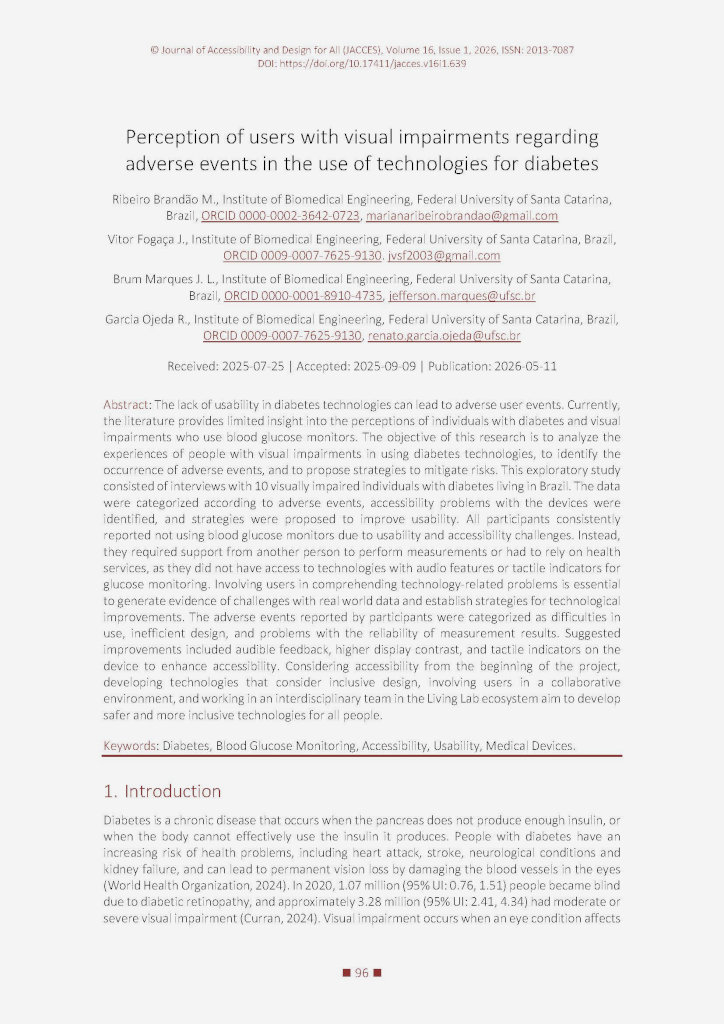
Perception of users with visual impairments regarding adverse events in the use of technologies for diabetes
DOI:
https://doi.org/10.17411/jacces.v16i1.639Abstract
The lack of usability in diabetes technologies can lead to adverse user events. Currently, the literature provides limited insight into the perceptions of individuals with diabetes and visual impairments who use blood glucose monitors. The objective of this research is to analyze the experiences of people with visual impairments in using diabetes technologies, to identify the occurrence of adverse events, and to propose strategies to mitigate risks. This exploratory study consisted of interviews with 10 visually impaired individuals with diabetes living in Brazil. The data were categorized according to adverse events, accessibility problems with the devices were identified, and strategies were proposed to improve usability. All participants consistently reported not using blood glucose monitors due to usability and accessibility challenges. Instead, they required support from another person to perform measurements or had to rely on health services, as they did not have access to technologies with audio features or tactile indicators for glucose monitoring. Involving users in comprehending technology-related problems is essential to generate evidence of challenges with real world data and establish strategies for technological improvements. The adverse events reported by participants were categorized as difficulties in use, inefficient design, and problems with the reliability of measurement results. Suggested improvements included audible feedback, higher display contrast, and tactile indicators on the device to enhance accessibility. Considering accessibility from the beginning of the project, developing technologies that consider inclusive design, involving users in a collaborative environment, and working in an interdisciplinary team in the Living Lab ecosystem aim to develop safer and more inclusive technologies for all people.
References
Akturk, H. K., Snell-Bergeon, J. K., & Shah, V. N. (2020). Continuous glucose monitor with Siri integration improves glycemic control in legally blind patients with diabetes. Diabetes Technology & Therapeutics, 23(3), 213–216. https://doi.org/10.1089/dia.2020.0320
Americans with Disabilities Act (ADA). (2022). Access to medical care for individuals with mobility disabilities. ADA.gov. https://www.ada.gov/resources/medical-care-mobility
Blubaugh, M. V., & Uslan, M. M. (2012). Accessibility attributes of blood glucose meter and home blood pressure monitor displays for visually impaired persons. Journal of Diabetes Science and Technology, 6(2), 246–251.https://doi.org/10.1177/193229681200600206
Brandao, M., & Garcia, R. (2024). Analysis of accessibility problems in medical devices. International Journal on Advances in Life Sciences, 16(3–4), 178–187. https://www.thinkmind.org/library/LifSci/LifSci_v16_n34_2024/lifsci_v16_n34_2024_7.html
Burton, D. M., Enigk, M. G., & Lilly, J. W. (2012). Blood glucose meters and accessibility to blind and visually impaired people. Journal of Diabetes Science and Technology, 6(2), 242–245. https://doi.org/10.1177/193229681200600205
Creswell, J. W. (2010). Research design: Qualitative, quantitative, and mixed methods approaches (M. Lopes, Trans.; 3rd ed.)
Curran, K., Peto, T., Jonas, J. B., Friedman, D., Kim, J. E., Leasher, J., Tapply, I., Fernandes, A. G., Cicinelli, M. V., Arrigo, A., Leveziel, N., Resnikoff, S., Taylor, H. R., Sedighi, T., Flaxman, S., Bikbov, M. M., Braithwaite, T., Bron, A., Cheng, C.-Y., & Delcourt, C. (2024). Global estimates on the number of people blind or visually impaired by diabetic retinopathy: A meta-analysis from 2000 to 2020. Eye, 38(11), 2047–2057. https://doi.org/10.1038/s41433-024-03101-5
Dandona, L., & Dandona, R. (2006). Revision of visual impairment definitions in the International Statistical Classification of Diseases. BMC Medicine, 4(1), Artículo 7. https://doi.org/10.1186/1741-7015-4-7
Heinemann, L., Drossel, D., Freckmann, G., & Kulzer, B. (2016). Usability of medical devices for patients with diabetes who are visually impaired or blind. Journal of Diabetes Science and Technology, 10(6), 1382–1387. https://doi.org/10.1177/1932296816666536
Heydarian, N. M., Brown-Podgorski, B., & Ramirez, J. (2021). Visual impairment and self-efficacy in diabetes management. The Science of Diabetes Self-Management and Care, 47(5), 346–354. https://doi.org/10.1177/26350106211033811
Macdonald, C., Lunt, H., Downie, M., & Kendall, D. (2017). How satisfied are patients when their choice of funded glucose meter is restricted to a single brand? Journal of Diabetes Science and Technology, 11(5), 1001–1006. https://doi.org/10.1177/
1932296817693016
Malhotra, N. K. (2001). Marketing research: An applied orientation (N. Montingelli Jr. & A. A. de Farias, Trans.). Bookman.
Nguyen, C., Lim, L., Conard, E., & Okere, A. N. (2024). Accessibility of diabetes therapy management for patients with visual impairment. Innovations in Pharmacy, 15(3), Artículo 2. https://doi.org/10.24926/iip.v15i3.6233
Pan American Health Organization. (s.f.). Visual health. https://www.paho.org/en/topics/visual-health
Santonen, T., Petsani, D., Julin, M., Garschall, M., Kropf, J., Van der Auwera, V., Bernaerts, S., Losada, R., Almeida, R., Garatea, J., Muñoz, I., Nagy, E., Kehayia, E., de Guise, E., Nadeau, S., Azevedo, N., Segkouli, S., Lazarou, I., Petronikolou, V., & Bamidis, P. (2022). Cocreating a harmonized living lab for big data–driven hybrid persona development: Protocol for cocreating, testing, and seeking consensus. JMIR Research Protocols, 11(1), Artículo e34567. https://doi.org/10.2196/34567
Story, M. F., Schwier, E., & Kailes, J. I. (2009). Perspectives of patients with disabilities on the accessibility of medical equipment: Examination tables, imaging equipment, medical chairs, and weight scales. Disability and Health Journal, 2(4), 169–179.e1. https://doi.org/10.1016/j.dhjo.2009.05.003
Uslan, M. M., Eghtesadi, K., & Burton, D. (2003). Accessibility of blood glucose monitoring systems for blind and visually impaired people. Diabetes Technology & Therapeutics, 5(3), 439–448. https://doi.org/10.1089/152091503765691947
World Health Organization. (2023). Blindness and vision impairment. https://www.who.int/news-room/fact-sheets/detail/blindness-and-visual-impairment
World Health Organization. (2024). Diabetes. https://www.who.int/news-room/fact-sheets/detail/diabetes
Yee, S., & Breslin, M. L. (2010). Achieving accessible health care for people with disabilities: Why the ADA is only part of the solution. Disability and Health Journal, 3(4), 253–261. https://doi.org/10.1016/j.dhjo.2010.07.006
Zipfel, N., Horreh, B., Hulshof, C. T. J., de Boer, A. G. E. M., & van der Burg-Vermeulen, S. J. (2022). The relationship between the living lab approach and successful implementation of healthcare innovations: An integrative review. BMJ Open, 12(6), Artículo e058630. https://doi.org/10.1136/bmjopen-2021-058630
Downloads
Published
Issue
Section
License
Copyright (c) 2026 Mariana Ribeiro Brandão, João Vitor Fogaça, Jefferson Luiz Brum Marques, Renato Garcia Ojeda

This work is licensed under a Creative Commons Attribution-NonCommercial 4.0 International License.
- Authors retain copyright and grant the journal right of first publication with the work simultaneously licensed under a Creative Commons Attribution License that allows others to share or adapt the work with an acknowledgment of the work's authorship and initial publication in this journal. Use of the work for commercial purposes are not allowed.
- Authors are able to publish the journal's published version of the work in other media (e.g., post it to an institutional repository or publish it in a book), as far as they inform the Journal of Accessibility and Design for All of that fact. When publishing their work in other sources, authors must mention the name of the Journal of Accessibility and Design for All, its ISSN, the number and issue in which the article was published and a link to the main page of the Journal of Accessibility and Design for All. Optionally, they can also include a link to the article published in the Journal of Accessibility and Design for All.
- Authors are permitted and encouraged to post their work online (e.g., in institutional repositories or on their website), as it can lead to productive exchanges, as well as earlier and greater citation of published work.