A web content audit of accessibility and linguistic inclusivity for students with disabilities on SAARC countries university websites
DOI:
https://doi.org/10.17411/jacces.v16i1.709Abstract
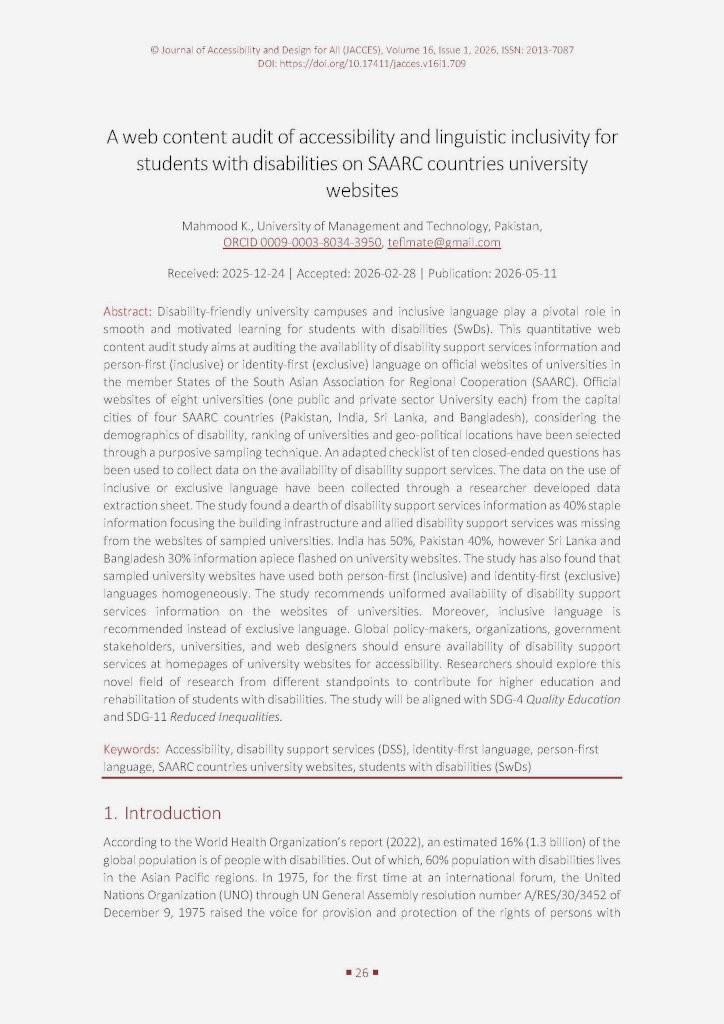
Disability-friendly university campuses and inclusive language play a pivotal role in smooth and motivated learning for students with disabilities (SwDs). This quantitative web content audit study aims at auditing the availability of disability support services information and person-first (inclusive) or identity-first (exclusive) language on official websites of universities in the member States of the South Asian Association for Regional Cooperation (SAARC). Official websites of eight universities (one public and private sector University each) from the capital cities of four SAARC countries (Pakistan, India, Sri Lanka, and Bangladesh), considering the demographics of disability, ranking of universities and geo-political locations have been selected through a purposive sampling technique. An adapted checklist of ten closed-ended questions has been used to collect data on the availability of disability support services. The data on the use of inclusive or exclusive language have been collected through a researcher developed data extraction sheet. The study found a dearth of disability support services information as 40% staple information focusing the building infrastructure and allied disability support services was missing from the websites of sampled universities. India has 50%, Pakistan 40%, however Sri Lanka and Bangladesh 30% information apiece flashed on university websites. The study has also found that sampled university websites have used both person-first (inclusive) and identity-first (exclusive) languages homogeneously. The study recommends uniformed availability of disability support services information on the websites of universities. Moreover, inclusive language is recommended instead of exclusive language. Global policy-makers, organizations, government stakeholders, universities, and web designers should ensure availability of disability support services at homepages of university websites for accessibility. Researchers should explore this novel field of research from different standpoints to contribute for higher education and rehabilitation of students with disabilities. The study will be aligned with SDG-4 Quality Education and SDG-11 Reduced Inequalities.
References
Ahmed, M., & Khan, A. B. (2011). The policies of United Nations and their implementation: A comparative study of policy implementation in Pakistan. Journal of Political Studies, 18(1), 125–140.
Ahmed, M., Khan, A. B., & Naseem, F. (2011). Policies for special persons in Pakistan: Analysis of policy implementation. Berkley Journal of Social Sciences, 1(2).
American Psychological Association. (2020). Publication manual of the American Psychological Association (7th ed.). https://doi.org/10.1037/0000165-000
Asia Pacific Institute of Information Technology (APIIT). (2023). APIIT Sri Lanka. https://www.apiit.lk
Autistic Self Advocacy Network. (2019). Identity-first language: Why it matters? https://autisticadvocacy.org/about-asan/identity-first-language/
Bhuiyan, M. H. M., Varvello, M., Staicu, C.-A., & Zaki, Y. (2025). Non-Western perspectives on web inclusivity: A study of accessibility practices in the Global South. arXiv. https://doi.org/10.48550/arXiv.2501.16601
Brinckerhoff, L. C., McGuire, J. M., & Shaw, S. F. (2002). Postsecondary education and transition for students with learning disabilities (2nd ed.). PRO-ED.
Cerilli, C., Zhu, J., Varadaraj, V., Campanile, J., Sweeney, F., Smith, J., & Swenor, B. (2025). Gaps in disability inclusion across universities in the United States. PLOS ONE, 20(1), Artículo e0317920. https://doi.org/10.1371/journal.pone.0317920
Coomes, M. D., & DeBard, R. (Eds.). (2004). Serving the millennial generation (New Directions for Student Services, No. 106). Jossey-Bass. https://doi.org/10.1002/ss.121
Directorate General of Special Education. (2006). The national plan of action for the persons with disabilities. Government of Pakistan.
Friedman, M. (2004, 15–20 de marzo). Assistive technology research and development collaborative on cognitive disabilities [Presentación de documento]. 19th Annual International Conference on Technology and Persons with Disabilities, Los Angeles, CA, Estados Unidos.
Government of Bangladesh. (2001). Bangladesh persons with disability welfare act, 2001.
Government of India. (2016). The rights of persons with disabilities act, 2016.
Government of Pakistan. (1981). Disabled persons (employment and rehabilitation) ordinance, 1981.
Government of Pakistan. (2008). The special citizens' act, 2008 (Act No. 24 of 2008).
Government of Sri Lanka. (2003). National policy on disability rights.
Grech, L. B., Koller, D., & Olley, A. (2024). Person-first and identity-first disability language: Informing client-centered care. Social Science & Medicine, 362, Artículo 117444. https://doi.org/10.1016/j.socscimed.2024.117444
Harpur, P., Stafford, L., & Ellis, K. (2025). A disability-led disability inclusion strategy for the higher education sector. Journal of Higher Education Policy and Management, 47(3), 368–385. https://doi.org/10.1080/1360080X.2024.2374465
Hassan, L. (2013). Heuristic evaluation of three Jordanian university websites. Informatics in Education, 12(2), 231–251. https://doi.org/10.15388/infedu.2013.12
Higher Education Commission of Pakistan. (n.d.). Disability policy HEC. https://www.hec.gov.pk
Higher Education Commission of Pakistan. (n.d.). HEC recognized universities. https://www.hec.gov.pk/english/universities/pages/recognised.aspx
Higher Education Department. (2013, 7 de noviembre). Notification number S.O (A-II) 1–83/2012. Government of the Punjab.
Iqbal, N. (2023, 21 de enero). SC bars use of word “disabled” in official correspondence. DAWN. https://www.dawn.com/news/1732820
Irwin, M., & Gerke, J. (2004). Web-based information and prospective students with disabilities: A study of liberal arts colleges. EDUCAUSE Quarterly, 27(4), 51–59.
Jackson, D. L., & Jones, S. J. (2014). A virtual commitment: Disability services information on public community college websites. Journal of Postsecondary Education and Disability, 27(2), 129–138.
Jankovic, D. (2020, 27 de abril). How to conduct a websites content analysis to discover insights & opportunities. DivvyHQ. https://divvyhq.com/tips-how-tos/how-to-conduct-website-content-analysis/
Kalyanwala, S., Singh, S., & Iqbal, M. (2019). Review of evidence on disability programmes in South Asia. Amaltas Consulting. https://www.gov.uk/research-for-development-outputs/review-of-evidence-on-disability-programmes-in-south-asia-amaltas-consulting-new-delhi
Mahmood, K. (2016). A Virtual Face: Disability Services Information on Universities’Websites. Linguistics and Literature Review, 2(2), 93–107. https://journals.umt.edu.pk/index.php/llr/article/download/259/253
Majchrzak, A. (1984). Methods for policy research. SAGE Publications.
Meyer, K. A. (2008b). The "virtual face" of institutions: Why legislators and other outsiders view higher education as aloof. The Internet and Higher Education, 11(3–4), 178–185. https://doi.org/10.1016/j.iheduc.2008.06.008
Meyer, K. A., & Jones, S. J. (2011). Information found and not found: What university websites tell students. Online Journal of Distance Learning Administration, 14(3).
Milsom, A., & Hartley, M. T. (2005). Assisting students with learning disabilities transitioning to college: What school counselors should know. Professional School Counseling, 8(5), 436–441.
Ministry of Women Development, Social Welfare and Special Education. (2002). National policy for persons with disabilities. Government of Pakistan.
Naz, S., Akhtar, S., Nawaz, Y., & Yasin, G. (2010). Modes of social adjustment of physically handicapped children: An investigation of parents point of view. Pakistan Journal of Agricultural Sciences, 47(3), 295–299.
North South University. (2025). Home. http://www.northsouth.edu
Population Census Organization. (1998). Report on national census of Pakistan, 1998. Government of Pakistan.
Quaid-i-Azam University. (2026). Home. https://www.qau.edu.pk
Riphah International University. (2024). Home. https://www.riphah.edu.pk
Shaheen, I. (2013). South Asian Association for Regional Cooperation (SAARC): Its role, hurdles and prospects. IOSR Journal of Humanities and Social Science, 15(6), 1–9. https://doi.org/10.9790/0837-1560109
Sharda University. (2026). Home. https://www.sharda.ac.in
Sharif, A., McCall, A. L., & Bolante, K. R. (2022). Should I say “disabled people” or “people with disabilities”? Language preferences of disabled people between identity- and person-first languages. Proceedings of the 24th International ACM SIGACCESS Conference on Computers and Accessibility. https://doi.org/10.1145/3517428.3544813
Smith, J. (2021). Exploring language preferences among individuals with disabilities. Disability Studies Journal, 8(2), 112–125.
Solovieva, T. I., & Bock, J. M. (2014). Monitoring for accessibility and university websites: Meeting the needs of people with disabilities. Journal of Postsecondary Education and Disability, 27(2), 113–127.
Taboas, A., Doepke, K., & Zimmerman, C. (2023). Preferences for identity-first versus person-first language in a U.S. sample of autism stakeholders. Autism, 27(6), 1492–1507. https://doi.org/10.1177/13623613221130845
The Economist Intelligence Unit. (2014). Moving from the margins: Mainstreaming persons with disabilities in Pakistan.
United Nations. (2006). Convention on the rights of persons with disabilities. https://www.un.org/development/desa/disabilities/convention-on-the-rights-of-persons-with-disabilities.html
United Nations General Assembly. (1975). Declaration on the rights of disabled persons (A/RES/30/3447). http://www.un-documents.net/a30r3447.htm
United Nations General Assembly. (1982). World programme of action concerning disabled persons (A/RES/37/52). https://www.un.org/documents/ga/res/37/a37r052.htm
University of Colombo. (n.d.). Home. https://cmb.ac.lk
University of Delhi. (2024). Home. https://www.du.ac.in
University of Dhaka. (2025). Home. https://www.du.ac.bd
Wedasinghe, N., Sirisoma, N. T., & Wickramarachchi, A. P. R. (2023). A design guideline to overcome web accessibility issues challenged by visually impaired community in Sri Lanka. arXiv. https://doi.org/10.48550/arXiv.2304.06924
Wilson, J. L., & Meyer, K. A. (2009). Higher education websites: The "virtual face" of diversity. Journal of Diversity in Higher Education, 2(2), 91–102. https://doi.org/10.1037/a0014963
Downloads
Published
Issue
Section
License
Copyright (c) 2026 Khalid Mahmood

This work is licensed under a Creative Commons Attribution-NonCommercial 4.0 International License.
- Authors retain copyright and grant the journal right of first publication with the work simultaneously licensed under a Creative Commons Attribution License that allows others to share or adapt the work with an acknowledgment of the work's authorship and initial publication in this journal. Use of the work for commercial purposes are not allowed.
- Authors are able to publish the journal's published version of the work in other media (e.g., post it to an institutional repository or publish it in a book), as far as they inform the Journal of Accessibility and Design for All of that fact. When publishing their work in other sources, authors must mention the name of the Journal of Accessibility and Design for All, its ISSN, the number and issue in which the article was published and a link to the main page of the Journal of Accessibility and Design for All. Optionally, they can also include a link to the article published in the Journal of Accessibility and Design for All.
- Authors are permitted and encouraged to post their work online (e.g., in institutional repositories or on their website), as it can lead to productive exchanges, as well as earlier and greater citation of published work.