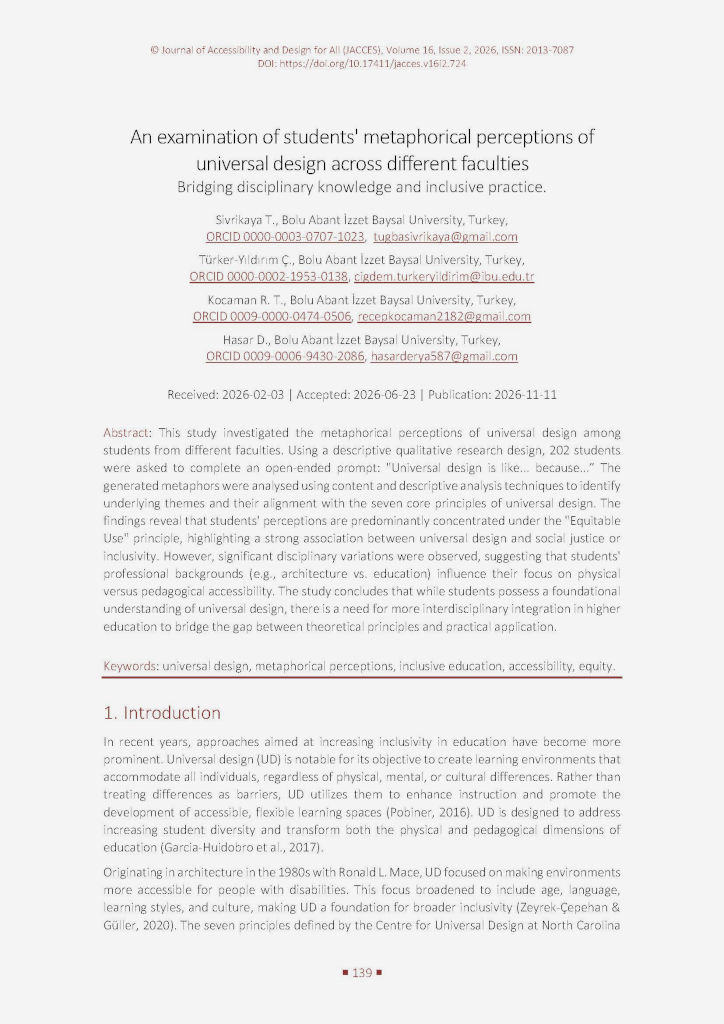
An examination of students' metaphorical perceptions of universal design across different faculties
Bridging disciplinary knowledge and inclusive practice.
DOI:
https://doi.org/10.17411/jacces.v16i2.724Abstract
This study investigated the metaphorical perceptions of universal design among students from different faculties. Using a descriptive qualitative research design, 202 students were asked to complete an open-ended prompt: "Universal design is like... because...” The generated metaphors were analysed using content and descriptive analysis techniques to identify underlying themes and their alignment with the seven core principles of universal design. The findings reveal that students' perceptions are predominantly concentrated under the "Equitable Use" principle, highlighting a strong association between universal design and social justice or inclusivity. However, significant disciplinary variations were observed, suggesting that students' professional backgrounds (e.g., architecture vs. education) influence their focus on physical versus pedagogical accessibility. The study concludes that while students possess a foundational understanding of universal design, there is a need for more interdisciplinary integration in higher education to bridge the gap between theoretical principles and practical application.
References
Almeqdad, Q.I., Alodat, A.M., Alquraan, M.F., Mohaidat, M.A. & Al-Makhzoomy, A.K. (2023) The effectiveness of universal design for learning: A systematic review of the literature and meta-analysis, Cogent Education, 10 (1), 2218191, https://doi.org/10.1080/2331186X.
2023.2218191
Bagrıacık-Yılmaz, A. (2019). Distance and face-to-face students’ perceptions towards distance education: A comparative metaphorical study. Turkish Online Journal of Distance Education, 20(1), 191–207. https://doi.org/10.17718/tojde.522705
Balıkçı, H. C., Hayoğlu, G., & Alpsülün, M. (2024). Determination of teachers’ perceptions of artificial ıntelligence concept: A metaphor analysis. Sakarya University Journal of Education, 14(Special Issue-AI in Education), 179–193. https://doi.org/10.19126/
suje.1433360
Bronfenbrenner, U. (1979). The ecology of human development: Experiments by nature and design. Harvard University Press. https://www.jstor.org/stable/j.ctv26071r6
Cohen, J. (1960). A Coefficient of agreement for nominal scales. Educational and Psychological Measurement, 20(1), 37-46. https://doi.org/10.1177/001316446002000104
Cole, J. Y., Graham, J., Norvell, S., & Schaber, P. (2024). Universal Design for Learning Principles Impact on Students with Neurodiverse Learning Styles. Journal of Occupational Therapy Education, 8(2), 4. https://files.eric.ed.gov/fulltext/EJ1437958.pdf
Dolmage, J. T. (2017). Academic ableism: Disability and higher education (p. 244). University of Michigan Press. https://doi.org/10.3998/mpub.9708722
Durgungöz, F. C., & Durgungöz, A. (2025). Interactive lessons are great, but too much is too much: Hearing out neurodivergent students, Universal Design for Learning and the case for integrating more anonymous technology in higher education. Higher Education. https://doi.org/10.1007/s10734-024-01389-6
Espada-Chavarría, R. M., González-Montesino, R. H., López-Bastías, J. L., & Díaz-Vega, M. (2023). Universal design for learning and instruction: Effective strategies for inclusive higher education. Education Sciences, 13(6), 620. https://doi.org/10.3390/educsci13060620
Fernando, T. (2026). Embracing neurodiversity in education: A review of ınclusive practices, policies, and pedagogies. Schores Journal of Education Research, 2(2). https://schores.org/journals/sjer/article/view/65
Freire, P. (2000). Pedagogy of the oppressed (30th anniv. ed.). New York: Continuum, 35. https://fsi-ebcao.princeton.edu/sites/g/files/toruqf1411/files/media/freire.pdf
Garcia-Huidobro, J. C., Thompson, K., Bacon, C. K., & Nannemann, A. (2017). Evolution in educational change: A literature review of the historical core of the Journal of Educational Change. Journal of Educational Change, 18(3), 263–293. https://doi.org/10.1007/
s10833-017-9298-8
Guffey, E. (2018). Designing disability: Symbols, spaces, and society. Bloomsbury Academic. https://librarysearch.bates.edu/permalink/01CBB_BCOLL/fumis3/cdi_proquest_ebookcentralchapters_5149158_3_10
Harrison, M., Rowlings, J., White, E. H., Vallence, M., & Potemkin, N. (2024). Neurodiversity and digital inclusion: Creating the conditions for inclusive education through universal design for learning [Commissioned report]. The University of Melbourne and SMART Technologies. https://doi.org/10.17613/sj8sk-vts95
Hofman, R., & Kilimo, J. (2014). Teachers’ attitudes and self-efficacy towards inclusion of pupils with disabilities in tanzanian schools. Journal of Education and Training, 1(2), 177. https://doi.org/10.5296/jet.v1i2.5760
Jensen, D. (2006). Metaphors as a bridge to understanding educational and social contexts. International Journal of Qualitative Methods, 5(1), 36–54. https://doi.org/10.1177/
160940690600500104
Jones, P. (2014, October 15–17). Design methods for systemic design research [Paper presentation]. RSD3, Third Symposium of Relating Systems Thinking to Design, Oslo, Norway. http://openresearch.ocadu.ca/id/eprint/2083
Karisa, A. (2023) Universal design for learning: not another slogan on the street of inclusive education, Disability & Society, 38 (1), 194-200, https://doi.org/10.1080/09687599.
2022.2125792
Khalil, D., Ramzy, O., & Mostafa, R. (2013). Perception towards sustainable development concept: egyptian students' perspective. Sustainability Accounting Management and Policy Journal, 4(3), 307-327. https://doi.org/10.1108/sampj-01-2013-0008
Lahti, J. (2023). Accessibility status of e-commerce sites of finnish universities of applied sciences. EDULEARN Proceedings, 1, 1828-1833. https://doi.org/10.21125/edulearn.2023.0555
Lakoff, G., & Johnson, M. (1980). Metaphors we live by. University of Chicago Press. https://press.uchicago.edu/ucp/books/book/chicago/M/bo3637992.html
Landau, M. J., Barrera, J., & Keefer, L. A. (2017). On the road: combining possible identities and metaphor to motivate disadvantaged middle-school students. Metaphor and Symbol, 32(4), 276-290. https://doi.org/10.1080/10926488.2017.1384271
Landis, J. R., & Koch, G. G. (1977). The measurement of observer agreement for categorical data. Biometrics, 33(1), 159. https://doi.org/10.2307/2529310
Levey, J. A. (2018). Universal Design for Instruction in Nursing Education: An Integrative Review. Nursing Education Perspectives, 39(3), 156–161. https://doi.org/10.1097/01.nep.
0000000000000249
Littlemore, J. (2001). The use of metaphor in university lectures and the problems that it causes for overseas students. Teaching in Higher Education, 6(3), 333–349. https://doi.org/10.1080/13562510120061205
Meyer, A., Rose, D. H., & Gordon, D. (2014). Universal design for learning: Theory and practice. CAST Professional Publishing. Retrieved 30 03, 2026, http://udltheorypractice.cast.org
Miles, M. B., & Huberman, A. M. (1994). Qualitative data analysis: An expanded sourcebook. Sage.
Moore, S. (2007). David H. Rose, Anne Meyer, Teaching every student in the digital Age: Universal design for learning. Educational Technology Research and Development, 55(5), 521-525. https://doi.org/10.1007/s11423-007-9056-3
Nussbaum, M. C. (2011). Creating capabilities: The human development approach. Harvard University Press. https://books.google.com.tr/books/about/Creating_Capabilities.html?
id=Gg7Q2V8fi8gC&redir_esc=y
Parpala, A., Litmanen, T., Komulainen, E., Hirsto, L., & Lindblom‐Ylänne, S. (2010). Students’ approaches to learning and their experiences of the teaching–learning environment in different disciplines. British Journal of Educational Psychology, 80(2), 269–282. https://doi.org/10.1348/000709909x476946
Pobiner, B. (2016). Accepting, understanding, teaching, and learning (human) evolution: Obstacles and opportunities. American Journal of Physical Anthropology, 159(Suppl 61), 232–274. https://doi.org/10.1002/ajpa.22910
Power, D. (2000). Principles and practices of literacy development for deaf learners: a historical overview. Journal of Deaf Studies and Deaf Education, 5(1), 3–8. https://doi.org/10.1093/deafed/5.1.3
Priyadharsini, V., & Sahaya-Mary, R. (2024). Universal design for learning (UDL) in inclusive education: Accelerating learning for all. Shanlax International Journal of Arts, Science and Humanities, 11(4), 145-150. https://doi.org/10.34293/sijash.v11i4.7489
Rawls, J. (1999). A theory of justice (Rev. ed.). Harvard University Press. https://books.google.com.tr/books/about/A_Theory_of_Justice.html?hl=id&id=b7GZr5Btp30C&redir_esc=y
Reyes, J. I., Meneses, J., & Melián, E. (2022). A systematic review of academic interventions for students with disabilities in Online Higher Education. European Journal of Special Needs Education, 37(4), 569–586. https://doi.org/10.1080/08856257.2021.1911525
Rose, D. (2001). Universal design for learning. Journal of Special Education Technology, 16(4), 64-67. https://doi.org/10.1177/016264340101600411
Saban, A. (2006). Functions of metaphor in teaching and teacher education: A review essay. Teaching Education, 17(4), 299–315. https://doi.org/10.1080/10476210601017386
Saban, A., Koçbeker, B. N., & Saban, A. (2006). An investigation of the concept of teacher among prospective teachers through metaphor analysis. Educational Sciences: Theory & Practice, 6(2), 509-522. https://www.proquest.com/openview/fee52040bf3c44ec
5a2c3d5e030ce0e3/1?cbl=28575&pq-origsite=gscholar
Saldana, J. (2015). Thinking qualitatively: Methods of mind. SAGE. https://methods.sagepub.com/book/mono/thinking-qualitatively/toc
Schuck, R. K., & Fung, L. K. (2024). A dual design thinking–universal design approach to catalyze neurodiversity advocacy through collaboration among high-schoolers. Frontiers in psychiatry, 14, 1250895. https://doi.org/10.3389/fpsyt.2023.1250895
Schmitt, R. (2005). Systematic metaphor analysis as a method of qualitative research. The Qualitative Report, 10(2). https://doi.org/10.46743/2160-3715/2005.1854
Shi, W., Yu, Q., Moses, H., Krutz, D. E., & Malachowsky, S. (2023). ALL: Supporting experiential accessibility education and inclusive software development. ACM Transactions on Software Engineering and Methodology, 33(2), 1–30. https://doi.org/10.1145/3625292
Singer, S. R., & Smith, K. A. (2013). Discipline‐based education research: understanding and improving learning in undergraduate science and engineering. Journal of Engineering Education, 102(4), 468-471. https://doi.org/10.1002/jee.20030
Sivrikaya, T., Türker-Yıldırım, Ç., Kocaman, R. T., Hasar, D. (2025), An examination of students' metaphorical perceptions of universal design across different faculties. Mendeley Data, V1, https://doi.org/10.17632/b97rmwnhjf.1
Smedinga, M., Cienki, A., & Regt, H. W. d. (2023). Metaphors as tools for understanding in science communication among experts and to the public. Metaphor and the Social World, 13(2), 248-268. https://doi.org/10.1075/msw.22016.sme
Sousa , J. V. L., & Harb, M. da P. de A. A. (2025). Neurodiversity in higher education: The transformative role of assistive technologies in academic inclusion. Revista de Gestão Social e Ambiental, 19(6), 1-14. https://doi.org/10.24857/rgsa.v19n6-075
Stamenković, D., Ichien, N., & Holyoak, K. J. (2020). Individual differences in comprehension of contextualized metaphors. Metaphor and Symbol, 35(4), 285-301. https://doi.org/10.1080/10926488.2020.1821203
Stevens, H. L. (2019). Building access: Universal design and the politics of disability. Technical Communication Quarterly, 29(1), 99-102. https://doi.org/10.1080/10572252.2019.
1613337
Super, L., Hofmann, A., Leung, C., Ho, M., Harrower, E., Adreak, N., & Manesh, Z. R. (2020). Fostering equity, diversity, and inclusion in large, first‐year classes: using reflective practice questions to promote universal design for learning in ecology and evolution lessons. Ecology and Evolution, 11(8), 3464-3472. https://doi.org/10.1002/ece3.6960
Tang, A., Woldemariam, S., Roger, J., & Sirota, M. (2022). Translational bioinformatics to enable precision medicine for all: elevating equity across molecular, clinical, and digital realms. Yearbook of Medical Informatics, 31(01), 106-115. https://doi.org/10.1055/s-0042-1742513
Titchkosky, T. (2011). The question of access: Disability, space, meaning. University of Toronto Press. https://utppublishing.com/doi/book/10.3138/9781442610002
Vygotsky, L. S. (1978). Mind in society: The development of higher psychological processes. Harvard University Press. https://doi.org/10.2307/j.ctvjf9vz4
Vincent, A., Shnaikat, K., Marasco, E., & Barcomb, A. (2025). Categorizing Interactive Digital Learning Tools to Support Neurodivergent Students in Engineering Education. Proceedings of the Canadian Engineering Education Association (CEEA). https://doi.org/10.24908/pceea.2025.19579
Walters, S. (2010). Toward an accessible pedagogy: dis/ability, multimodality, and universal design in the technical communication classroom. Technical Communication Quarterly, 19(4), 427-454. https://doi.org/10.1080/10572252.2010.502090
Wang, Q., Gooden, A., Gu, H., Ma, H., & Pan, Y. (2022). Have we addressed internationalization sufficiently? Investigating British and Sino‐British postgraduate curricula with a postcolonial design perspective. The Curriculum Journal, 33(2), 203-221. https://doi.org/10.1002/curj.146
Yu, Y., Adu-Poku, K. A., Appiah, D., & Zulu, B. (2024). Integrating Rural Development, Education, and Management: Challenges and Strategies. Sustainability, 16(15), 6474. https://doi.org/10.3390/su16156474
Zallio, M., & Clarkson, P. J. (2023). A study to depict challenges and opportunities building industry professionals face when designing inclusive and accessible buildings. Architectural Science Review, 67(3), 268-279. https://doi.org/10.1080/00038628.2023.2270983
Zeyrek-Çepehan, İ., & Güller, E. (2020). Evrensel tasarım kapsamanda herkes i̇çi̇n eri̇şi̇lebi̇li̇r tasarım [Accessible design for everyone within the scope of universal design]. Sosyal Politika Çalışmaları Dergisi, 383-410. https://doi.org/10.21560/spcd.vi.818236
Downloads
Published
Issue
Section
License
Copyright (c) 2026 Sivrikaya T., Türker-Yıldırım Ç., Kocaman R. T., Hasar D.

This work is licensed under a Creative Commons Attribution-NonCommercial 4.0 International License.
- Authors retain copyright and grant the journal right of first publication with the work simultaneously licensed under a Creative Commons Attribution License that allows others to share or adapt the work with an acknowledgment of the work's authorship and initial publication in this journal. Use of the work for commercial purposes are not allowed.
- Authors are able to publish the journal's published version of the work in other media (e.g., post it to an institutional repository or publish it in a book), as far as they inform the Journal of Accessibility and Design for All of that fact. When publishing their work in other sources, authors must mention the name of the Journal of Accessibility and Design for All, its ISSN, the number and issue in which the article was published and a link to the main page of the Journal of Accessibility and Design for All. Optionally, they can also include a link to the article published in the Journal of Accessibility and Design for All.
- Authors are permitted and encouraged to post their work online (e.g., in institutional repositories or on their website), as it can lead to productive exchanges, as well as earlier and greater citation of published work.