Swimming pool accessibility
An analysis of not-for-profit community recreation facilities and collegiate recreational facilities
DOI:
https://doi.org/10.17411/jacces.v16i2.743Abstract
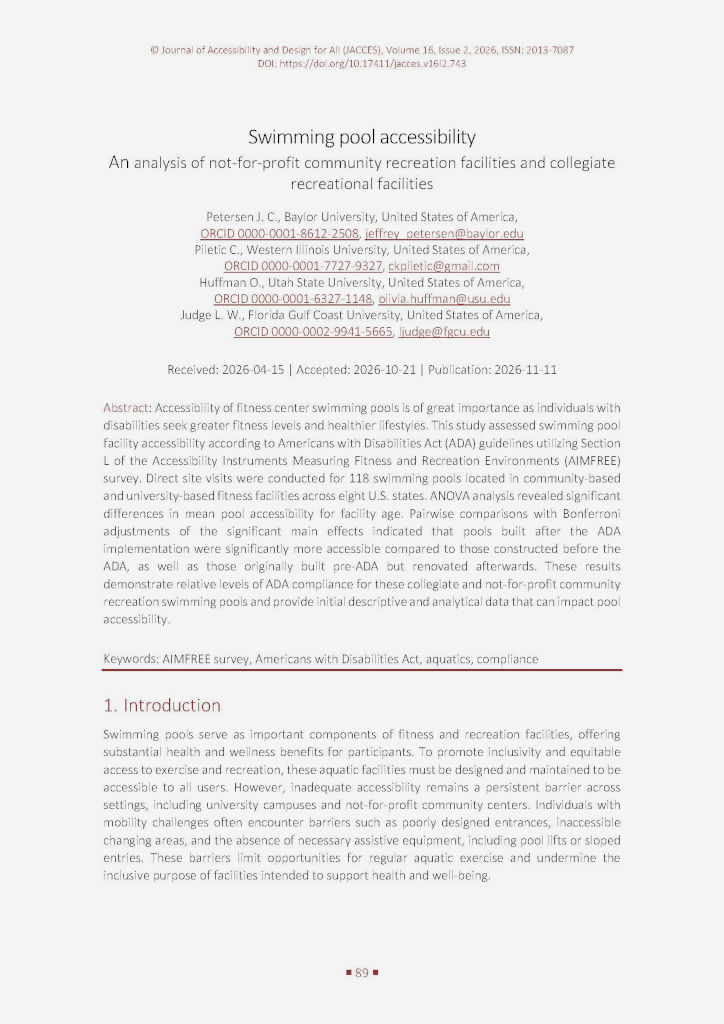
Accessibility of fitness center swimming pools is of great importance as individuals with disabilities seek greater fitness levels and healthier lifestyles. This study assessed swimming pool facility accessibility according to Americans with Disabilities Act (ADA) guidelines utilizing Section L of the Accessibility Instruments Measuring Fitness and Recreation Environments (AIMFREE) survey. Direct site visits were conducted for 118 swimming pools located in community-based and university-based fitness facilities across eight U.S. states. ANOVA analysis revealed significant differences in mean pool accessibility for facility age. Pairwise comparisons with Bonferroni adjustments of the significant main effects indicated that pools built after the ADA implementation were significantly more accessible compared to those constructed before the ADA, as well as those originally built pre-ADA but renovated afterwards. These results demonstrate relative levels of ADA compliance for these collegiate and not-for-profit community recreation swimming pools and provide initial descriptive and analytical data that can impact pool accessibility.
References
Anderson, S., Rivers, J., Appleton, G., & Goel, M. (1995). Americans with Disabilities Act: Issues for design and facility managers. Journal of Management Engineering, 11(1), 38–49. https://doi.org/10.1061/(ASCE)0742-597X(1995)11:1(38)
Arbour-Nicitopoulos, K. P., & Ginis, K. A. (2011). Universal accessibility of "accessible" fitness and recreational facilities for persons with mobility disabilities. Adapted Physical Education Quarterly, 28(1), 1-15. https://doi.org/10.1123/apaq.28.1.1
Archer, S. (2002). Aquatic exercise and arthritis. Aquatic Therapy Journal, 16(1), 29-31.
Becker, B. E. (2009). Aquatic therapy: Scientific foundations and clinical rehabilitation applications. Physical Medicine and Rehabilitation, 1(9), 859-872. https://doi.org/10.1016/j.pmrj.2009.05.017
Borson, S. (2010). Cognition, aging, and disabilities: Conceptual issues. Physical Medicine and Rehabilitation Clinics of North America, 21(2), 375–382. https://doi.org/10.1016/j.pmr.2010.01.001
Broach, E., & Dattilo, R. (2001). Effects of aquatic therapy on adults with multiple sclerosis. Therapeutic Recreation Journal, 35, 141-154.
Bumin, G., Uyanik, M., Yilmaz, I., Kayihan, H., & Topcu, M. (2003). Hydrotherapy for Rett syndrome. Journal of Rehabilitation Medicine, 35, 44-45.
Butzer, J. F., Virva, R., Kozlowski, A. J., Cistaro, R., & Perry, M. L. (2021). Participation by design: Integrating a social ecological approach with universal design to increase participation and add value for consumers. Disability and Health Journal, 14(2), 101006. https://doi.org/10.1016/j.dhjo.2020.101006
Caden, J. (2014). Americans with Disabilities Act, In T. Griffiths (Ed.) The complete swimming pool reference (3rd ed.). Sagamore Publishing.
Calder, A. M., & Mulligan, H. F. (2014). Measurement properties of instruments that assess inclusive access to fitness and recreational sports centers: a systematic review. Disability and Health Journal, 7(1), 26-35. https://doi.org/10.1016/j.dhjo.2013.06.003
Carbone, P. S., Smith, P. J., Lewis, C., & LeBlanc, C. (2021). Promoting the participation of children and adolescents with disabilities in sports, recreation, and physical activity. Pediatrics, 148(6). https://doi.org/10.1542/peds.2021-054664
Cardinal, B. J., & Spaziani, M. D. (2003). ADA compliance and the accessibility of physical activity facilities in Western Oregon. American Journal of Health Promotion, 17(3), 197-201. https://doi.org/10.4278/0890-1171-17.3.197
Cider, A., Sunnerhagen, K. S., Schaufelberger, M., & Andersson, B. (2005). Cardiorespiratory effects of warm water immersion in elderly patients with chronic heart failure. Clinical Physiology Function Imaging, 25(6), 313-317. https://doi.org/10.1111/j.1475-097X.2005.00633.x
Conatser, P. (2007). Adapted aquatics and rehabilitation: A literature synthesis. International Journal of Aquatic Research and Education, 1(3), 242-254. https://doi.org/10.25035/ijare.01.03.07
Connell, B. R., Jones, M., Mace, R., Mueller, J., Mullick, A., Ostroff, E., Sanford, J., Steinfeld, E., Story, M., & Vanderheiden, G. (1997). The principles of universal design (Version 2.0). Center for Universal Design, North Carolina State University. https://design.ncsu.edu/research/center-for-universal-design
Darby, L. A., & Yaekle, B. C. (2000). Physiological responses during two types of exercise performed on land and in the water. Journal of Sports Medicine and Physical Fitness, 40, 303-311.
Figoni, S. F., McClain, L., Bell, A. A., Degnan, J. M., Norbury, N. E., & Rettele, R. R. (1998). Accessibility of fitness facilities in the Kansas City metropolitan area. Topics in Spinal Cord Injury and Rehabilitation, 3(3), 66-78.
Figuers, C. (1999). Aquatic therapy intervention for a child diagnosed with spinal muscular atrophy Physical Therapy Case Report, 2, 109-112.
French, D., & Hainsworth, J. (2001). 'There aren't any buses and the swimming pool is always cold!': Obstacles and opportunities in the provision of sport for disabled people. Managing Leisure, 6(1), 35-49. https://doi.org/10.1080/13606710010026359
Houtenville, A., Bach, S., & Paul, S. (2023). Annual report on people with disabilities in America: 2023. University of New Hampshire, Institute on Disability. https://disabilitycompendium.org/sites/default/files/user-uploads/Accessible-Annual%20Report%20---%202023%20---%20Accessible.pdf
Hums, M. A., Schmidt, S. H., Novak, A., & Wolff, E. A. (2016). Universal design: Moving the Americans with Disabilities Act from access to inclusion. Journal of Legal Aspects of Sport, 26(1), 36-51. https://doi.org/10.1123/jlas.2015-0011
Hutzler, Y., Chaeham, A., Bergman, U., & Szeinberg, A. (1998). Effects of a movement and swimming program on vital capacity and water orientation skills of children with cerebral palsy. Developmental Medicine and Child Neurology, 40, 176-181. https://doi.org/10.1111/j.1469-8749.1998.tb15443.x
Johnson, M. J., Stoelzle, H. Y., Finco, K. L., Foss, S. E., & Carstens, K. (2012). ADA compliance and accessibility of fitness facilities in Western Wisconsin. Topics in Spinal Cord Injury Rehabilitation, 18(4), 340-353. https://doi.org/10.1310/sci1804-340
Koury, J. M. (1996). Aquatic therapy programming: Guidelines for orthopedic rehabilitation. Human Kinetics.
Kraus, L. (2015). 2015 disability statistics annual report. Durham, NH: University of New Hampshire. https://disabilitycompendium.org/sites/default/files/user-uploads/2015%20Annual%20Report%20%28PDF%29.pdf
Kung, S. P., & Taylor, P. (2014). The use of public sports facilities by the disabled in England. Sport Management Review, 17(1), 8-22. https://doi.org/10.1016/j.smr.2013.08.009
Rogers, D., & LaRue, R. J. (2019). Universal and accessible design: Creating facilities that work for all people. In T. H. Sawyer (Ed.), Facility planning and design for health, physical activity, recreation, and sport (14th ed.). (pp. 61-74). Sagamore Publishing.
Lieberman, L., Lytle, R., & Irwin, G. (2003). Ideas for including students with quadriplegia into physical education. Strategies, 17(2), 21-35. https://doi.org/10.1080/08924562.2003.10591069
Long, F. (2012). Access for All: Pool Lifts Required by Law for Entry and Exit. Rehabilitation Management: The Interdisciplinary Journal of Rehabilitation, 25(5), 22.
Martinez, C.A. (2006). Adapted aquatics for children with autism. Teaching Elementary Physical Education, 17(5), 34-37.
Michael, K. M., Allen, J. K., & Macko, R. F. (2005). Reduced ambulatory activity after stroke: the role of balance, gait, and cardiovascular fitness. Archives of Physical Medicine and Rehabilitation, 86(8), 1552-1556. https://doi.org/10.1016/j.apmr.2004.12.026
Nikolajsen, H., Sandal, L. F., Juhl, C. B., Troelsen, J., & Juul-Kristensen, B. (2021). Barriers to, and facilitators of, exercising in fitness centres among adults with and without physical disabilities: a scoping review. International Journal of Environmental Research and Public Health, 18(14), 7341. https://doi.org/10.3390/ijerph18147341
Petersen, J., & Piletic, C. (2006). Facility accessibility: Opening the doors to all. Journal of Physical Education, Recreation & Dance, 77(5), 38-44. https://doi.org/10.1080/07303084.2006.10597876
Pike, H., Walker, J., Collins, J., & Hodges, J. (2008). An investigation of ADA compliance of aquatic facilities in the North Texas area. American Journal of Health Promotion, 23(2), 139-146. https://doi.org/10.4278/ajhp.07041336
Piletic, C., Judge, L., & Petersen, J. (2013). Creating ADA accessible strength and conditioning facilities: The impact of the new 2010 standards. Journal of Facility Planning, Design, and Management, 1(1), 35-46.
Richardson, E. V., Smith, B., & Papathomas, A. (2017). Disability and the gym: Experiences, barriers and facilitators of gym use for individuals with physical disabilities. Disability and Rehabilitation, 39(19), 1950-1957. https://doi.org/10.1080/09638288.2016.1213893
Rider, R.A., & Modell, S. (1996). Aquatics for children with Angelman syndrome: Earning your water wings. Palaestra, 12(4), 28-33.
Riley, B, Rimmer, J. H., Wang, E., & Schiller, W. J. (2008). A conceptual framework for improving the accessibility of fitness and recreation facilities for people with disabilities. Journal of Physical Activity and Health, 5, 158-68. https://doi.org/10.1123/jpah.5.1.158
Rimmer, J. H., Padalabalanarayanan, S., Malone, L. A., & Mehta, T. (2017). Fitness facilities still lack accessibility for people with disabilities. Disability and Health Journal, 10(2), 214-221. https://doi.org/10.1016/j.dhjo.2016.12.011
Rimmer, J., & Riley, B. (2004). AIMFREE: Fitness center and swimming pool accessibility professional version. NCPAD and RECTECH, University of Illinois at Chicago. https://www.nchpad.org/wp-content/uploads/2024/06/AIMFREE_Fitness_Centerand_SwimmingPool_Accessibility_Professional_Version2_Revised_2013.pdf
Rimmer, J., Riley, B., Wang, E., & Rauworth, A. (2005). Accessibility of health clubs for people with mobility disabilities and visual impairments. American Journal of Public Health, 95(11), 2022–2028. https://doi.org/10.2105/AJPH.2004.051870
Rimmer J. H., Riley B., Wang E., & Rauworth, A. (2004). Development and validation of AIMFREE: Accessibility instruments measuring fitness and recreation environments. Disability and Rehabilitation, 26(18), 1087-1095. https://doi.org/10.1080/09638280410001711432
Rimmer, J. H., & Rowland, J. L. (2008). Health promotion for people with disabilities:
Implications for empowering the person and promoting disability-friendly environments. American Journal of Lifestyle Medicine, 2(5), 409-420. https://doi.org/10.1177/1559827608317397
Robledo, R. (2013). ADA lawsuits increase. Aquatics International, 25(5), 14.
Rosimini, C. (2003). Benefits of swim training for children and adolescents with asthma. Journal of the American Academy of Nurse Practitioners, 15(6), 247-252. https://doi.org/10.1111/j.1745-7599.2003.tb00394.x
Sholanke, A. B., & Eleagu, J. C. (2024). Appraisal of Universal Design strategies for enhancing social inclusion in the development of sporting facilities. IOP Conference Series: Earth and Environmental Science, 1342(1), 012024. https://doi.org/10.1088/1755-1315/1342/1/012024
Steinfeld, E., & Maisel, J. (2012). Universal design: Creating inclusive environments. Wiley.
U.S. Department of Justice. (2012). Accessible pools means of entry and exit. http://www.ada.gov/pools_2010.htm
U.S. Department of Justice. (2010). 2010 ADA Standards for Accessible Design. https://www.ada.gov/law-and-regs/design-standards/2010-stds
Vierling L. E. (2005). Assessing the impact of the ADA. The Case Manager, 16(1), 19–23.
https://doi.org/10.1016/j.casemgr.2004.11.002
Watchorn, V., Hitch, D., Tucker, R., Frawley, P., Aedy, K., & Grant, C. (2023). Evaluating universal design of built environments: An empirical study of stakeholder practice and perceptions. Journal of Housing and the Built Environment, 38(3), 1491-1510. https://doi.org/10.1007/s10901-022-09981-x
Weisgerber, M. C., Guill, M., Weisgerber, J. M., & Butler, H. (2003). Benefits of swimming in asthma: Effect of a session of swimming lessons on symptoms and PFTs with review of the literature. Journal of Asthma, 40, 453-464. https://doi.org/10.1081/JAS-120018706
West, B. (2013). Necessary accessory: ADA compliant pool lifts. Rehab Management: The Interdisciplinary Journal of Rehabilitation, 26(7), 26.
Yilmaz, L., Yanardag, M., Birkan, B., & Bumin, G. (2004). Effects of swimming training on physical fitness and water orientation in autism. Pediatrics International, 46, 624-626. https://doi.org/10.1111/j.1442-200x.2004.01938.x
Yoh, T., Mohr, M., & Gordon, B. (2008). Assessing satisfaction with campus recreation facilities among college students with physical disabilities. Recreational Sports Journal, 32(2), 106-113. https://doi.org/10.1123/rsj.32.2.106
Downloads
Published
Issue
Section
License
Copyright (c) 2026 Petersen J. C,, Piletic C., Huffman O., Judge L. W.

This work is licensed under a Creative Commons Attribution-NonCommercial 4.0 International License.
- Authors retain copyright and grant the journal right of first publication with the work simultaneously licensed under a Creative Commons Attribution License that allows others to share or adapt the work with an acknowledgment of the work's authorship and initial publication in this journal. Use of the work for commercial purposes are not allowed.
- Authors are able to publish the journal's published version of the work in other media (e.g., post it to an institutional repository or publish it in a book), as far as they inform the Journal of Accessibility and Design for All of that fact. When publishing their work in other sources, authors must mention the name of the Journal of Accessibility and Design for All, its ISSN, the number and issue in which the article was published and a link to the main page of the Journal of Accessibility and Design for All. Optionally, they can also include a link to the article published in the Journal of Accessibility and Design for All.
- Authors are permitted and encouraged to post their work online (e.g., in institutional repositories or on their website), as it can lead to productive exchanges, as well as earlier and greater citation of published work.