Mobile streaming applications for ADHD
Barriers, features, and design principles for neurodivergent accessibility
DOI:
https://doi.org/10.17411/jacces.v16i2.752Abstract
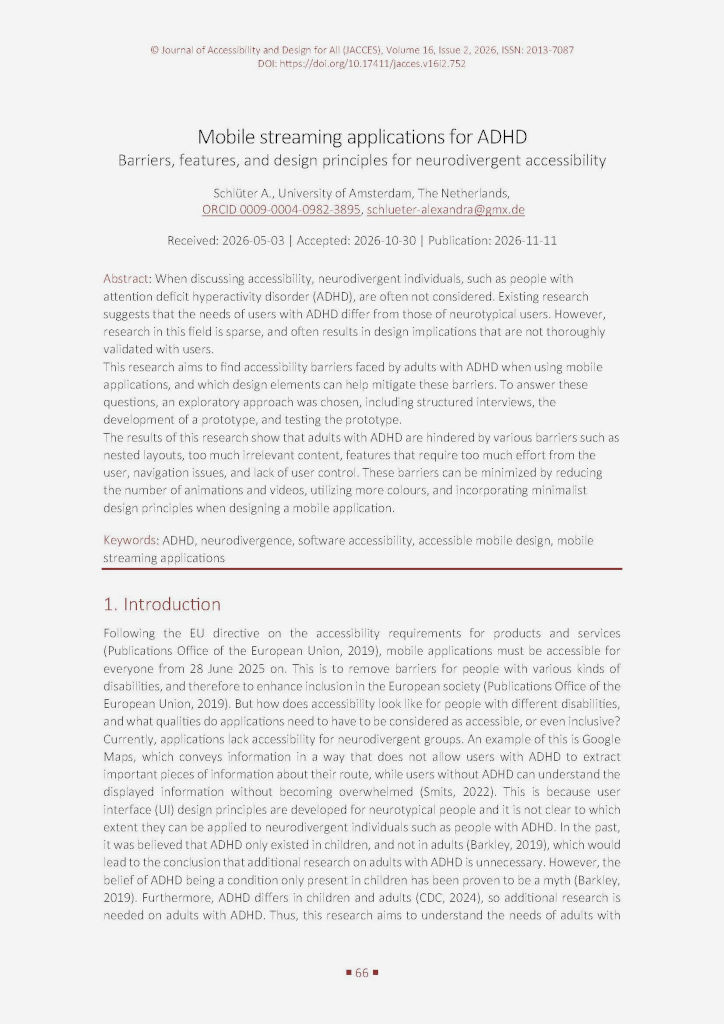
When discussing accessibility, neurodivergent individuals, such as people with attention deficit hyperactivity disorder (ADHD), are often not considered. Existing research suggests that the needs of users with ADHD differ from those of neurotypical users. However, research in this field is sparse, and often results in design implications that are not thoroughly validated with users.
This research aims to find accessibility barriers faced by adults with ADHD when using mobile applications, and which design elements can help mitigate these barriers. To answer these questions, an exploratory approach was chosen, including structured interviews, the development of a prototype, and testing the prototype.
The results of this research show that adults with ADHD are hindered by various barriers such as nested layouts, too much irrelevant content, features that require too much effort from the user, navigation issues, and lack of user control. These barriers can be minimized by reducing the number of animations and videos, utilizing more colours, and incorporating minimalist design principles when designing a mobile application.
References
Barkley, R. A. (2019). Myth: All Children Grow Out of ADHD. https://www.adhdawarenessmonth.org/wp-content/uploads/Grow-out-of-it-Barkley.pdf
CDC. (2024). ADHD in Adults: An Overview. https://www.cdc.gov/adhd/articles/adhd-across-the-lifetime.html
Crompton, C. J., Foster, S. J., Wilks, C. E., Dodd, M., Efthimiou, T. N., Ropar, D., . . . Fletcher-Watson, S. (2025). Information transfer within and between autistic and non-autistic people. (N. P. Group, Ed.) (9), 1488-1500. https://doi.org/10.1038/s41562-025-02163-z
Dirks, S. (2022). Ethical challenges in inclusive software development projects with people with cognitive disabilities: Ethische Herausforderungen in inklusiven Softwareentwicklungsprojekten mit Menschen mit kognitiven Beeinträchtigungen. Proceedings of Mensch und Computer 2022 (New York, NY, USA, 2022-09-15) (MuC ’22), pp. 556–560. https://doi.org/10.1145/3543758.3547575
Fessenden, T. (2021). Aesthetic and Minimalist Design (Usability Heuristic #8). (N. N. Group, Ed.) https://www.nngroup.com/articles/aesthetic-minimalist-design
Ginapp, C. M., Greenberg, N. R., Macdonald-Gagnon, G., Angarita, G. A., Bold, K. W., & Potenza, M. N. (2023). The experiences of adults with ADHD in interpersonal relationships and online communities: A qualitative study. SSM - Qualitative Research in Health(3). https://doi.org/10.1016/j.ssmqr.2023.100223
Hennink, M., & Kaiser, B. N. (2022). Sample sizes for saturation in qualitative research: A systematic review of empirical tests. Social Science & Medicine(292). https://doi.org/10.1016/j.socscimed.2021.114523
Kletenik, D., Minkowitz, R., Peric, A., Sahin, M., & Adler, R. F. (2024, March 7). From Awareness to Action: Teaching Software Accessibility for Neurodiverse Users. (A. f. Machinery, Ed.) Proceedings of the 55th ACM Technical Symposium on Computer Science Education V. 1, pp. 687–693. https://doi.org/10.1145/3626252.3630859
Nielsen, J. (1994). 10 Usability Heuristics for User Interface Design. (N. N. Group, Ed.) https://www.nngroup.com/articles/ten-usability-heuristics
Publications Office of the European Union. (2019, April). Directive (EU) 2019/882 of the European Parliament and of the Council of 17 April 2019 on the accessibility requirements for products and services (Text with EEA relevance). http://data.europa.eu/eli/dir/2019/882/oj/eng
Santos, T. (2022). Co-designing with neurodiverse population : Exploring how people with ADHD and dyslexia experience video streaming platforms (Dissertation). https://urn.kb.se/resolve?urn=urn:nbn:se:kth:diva-331580
Smits, N. (2022). "Less is More" - Making smartphone applications accessible for adults with ADHD. Unpublished. Submitted in partial fulfillment for the degree of master of science, University of Amsterdam
Turner, J. (2023). What do ADHDers Need? : Working Towards Establishing Guidelines and More Ethical Methods for Designing for and with the Neurodivergent (Dissertation). https://mau.diva-portal.org/smash/get/diva2:1767427/FULLTEXT02.pdf
Downloads
Published
Issue
Section
License
Copyright (c) 2026 Schlüter A.

This work is licensed under a Creative Commons Attribution-NonCommercial 4.0 International License.
- Authors retain copyright and grant the journal right of first publication with the work simultaneously licensed under a Creative Commons Attribution License that allows others to share or adapt the work with an acknowledgment of the work's authorship and initial publication in this journal. Use of the work for commercial purposes are not allowed.
- Authors are able to publish the journal's published version of the work in other media (e.g., post it to an institutional repository or publish it in a book), as far as they inform the Journal of Accessibility and Design for All of that fact. When publishing their work in other sources, authors must mention the name of the Journal of Accessibility and Design for All, its ISSN, the number and issue in which the article was published and a link to the main page of the Journal of Accessibility and Design for All. Optionally, they can also include a link to the article published in the Journal of Accessibility and Design for All.
- Authors are permitted and encouraged to post their work online (e.g., in institutional repositories or on their website), as it can lead to productive exchanges, as well as earlier and greater citation of published work.